The UK housing sector is entering a new phase, one defined not just by compliance, but by demonstrable accountability.
Since the introduction of the Social Housing Regulation Act 2023, the conversation has shifted. It’s no longer enough for housing providers to do the right thing. They must now be able to prove it; clearly, consistently, and often at short notice.
And in this new environment, operational processes that were once considered “back office” are coming under increasing scrutiny.
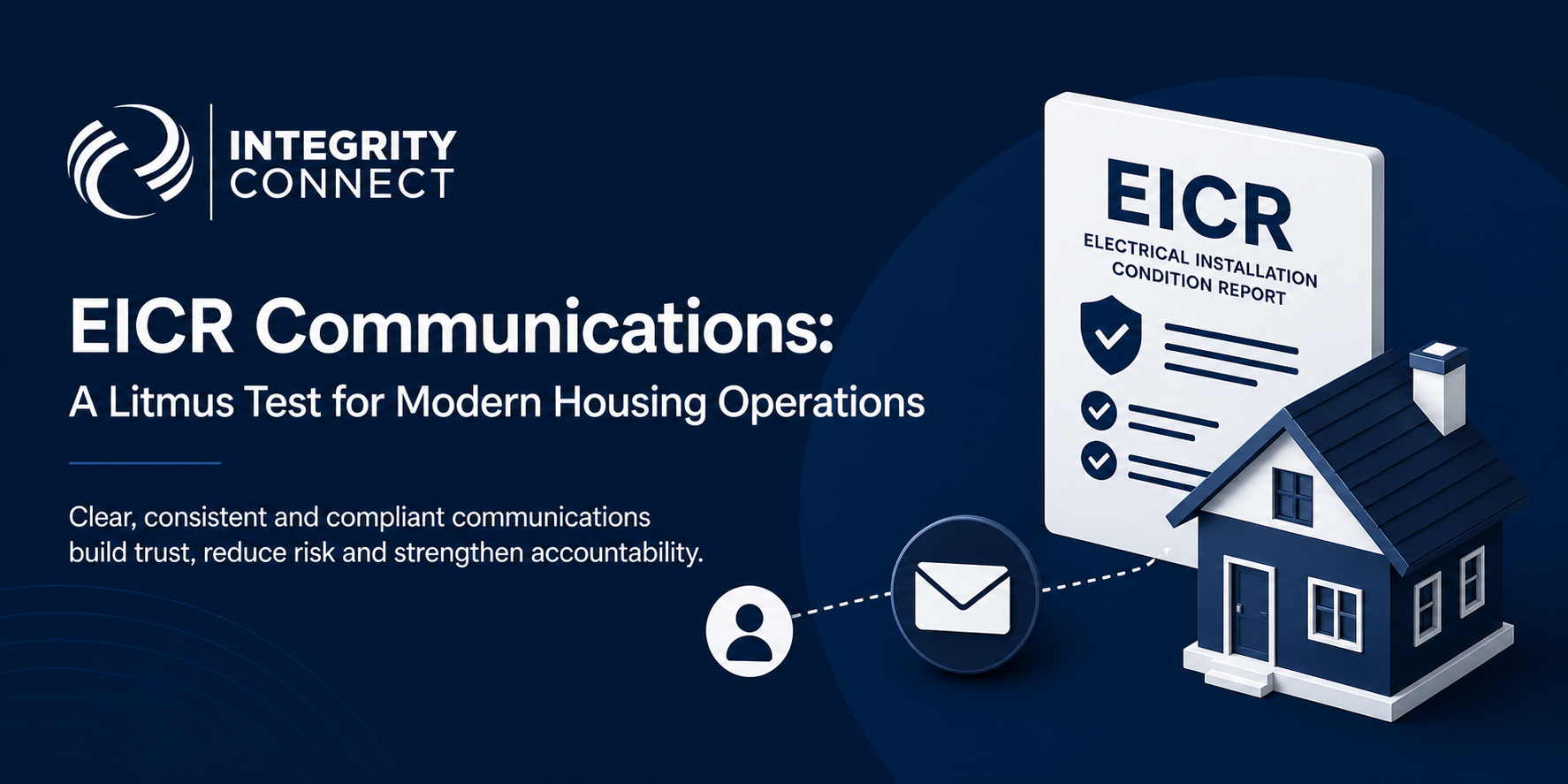
One of the clearest examples we have seen? Electrical Installation Condition Reports (EICR, sometimes referred to as EICR certificates or EICR reports) communications. Put simply, what is an EICR? It is the formal document produced following an electrical safety inspection, used to evidence compliance.
The Compliance Gap No One Talks About
Electrical safety compliance itself, including EICR testing and inspection processes, is well understood. The challenge lies elsewhere, in the communication of that compliance.
Across the sector, many organisations are still relying on processes that are:
- Fragmented across teams and systems
- Dependent on manual intervention
- Difficult to evidence retrospectively
This creates what might be called a “compliance gap,” that space between completing a regulatory task and being able to prove, beyond doubt, that it has been communicated correctly to the resident.
In a world of increasing regulation, that gap provides a potential hiding place for risk.
When Communication Becomes Evidence
What’s changing is the role that communication itself now plays.
An EICR certificate or EICR report is no longer just a document; it’s a key part of the audit trail. The way it is processed, presented, and delivered matters just as much as the technical compliance it represents.
This raises important questions for housing providers:
- Can you provide evidence of exactly what EICR documentation was sent, to whom, and when?
- Can you demonstrate consistency in how communications are presented?
- Can you respond quickly to regulatory enquiries with confidence?
If the answer to any of these is uncertain, the issue isn’t compliance, it’s process.
From Process to Platform Thinking
What we are seeing across the sector is a gradual shift away from task-based thinking towards platform-based communication models.
Rather than treating each EICR inspection or report as a standalone activity, leading organisations are rethinking the entire workflow, from contractor output through to resident engagement, as a single, connected process.
This is where technologies such as Clarity Connect hybrid mail are enabling a different approach:
- Standardising inputs from multiple contractors
- Structuring and enriching data automatically
- Embedding governance and auditability into every step
- Creating a single source of truth for communications
The key shift is subtle but significant: compliance is no longer managed at the end of the process; it is built into it from the start.
The Resident Dimension
There’s another layer to this that is often overlooked.
Regulation is not just about satisfying the regulator; it should be about serving residents more effectively.
Poorly presented or unclear EICR communications and reports can:
- Create confusion or anxiety
- Drive unnecessary inbound contact
- Undermine trust
Conversely, clear, consistent and well-structured communications can improve understanding, reduce friction, and reinforce confidence.
In that sense, EICR communications sit at the intersection of compliance and customer experience, a space that is becoming increasingly important across the housing sector.
A Sector at an Inflexion Point
What we’re observing, particularly among organisations within the Procurement for Housing community, is a growing recognition that legacy approaches are no longer sustainable.
Manual, fragmented processes may still “work” in a functional sense. But they struggle to meet the demands of:
- Real-time visibility
- End-to-end accountability
- Scalable, consistent communication
This is creating a natural inflexion point.
Some organisations will continue to optimise existing processes incrementally. Others are taking the opportunity to rethink them entirely.
Reframing the Opportunity
The Connect Team Perspective
From our perspective at Integrity Connect, the sector is at a defining moment.
Too many organisations are still trying to solve 2026 challenges with 2010 processes by layering incremental fixes onto fundamentally fragmented workflows. That approach is reaching its limit.
We believe the future lies in designed, not inherited, communication processes.
That means:
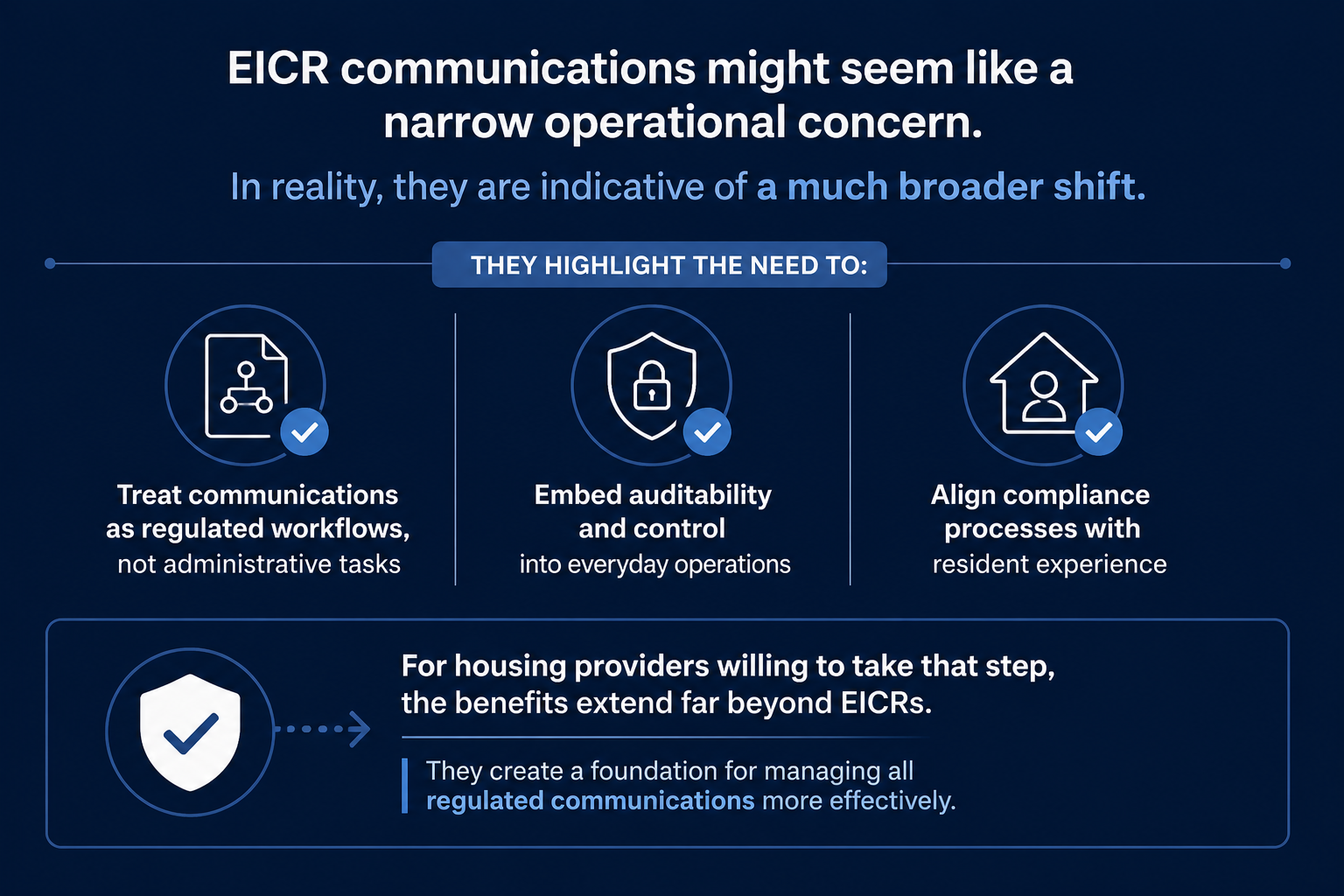
- Engineering compliance into workflows, rather than checking it at the end
- Treating every outbound communication as a controlled, auditable event
- Bringing together data, document handling, and delivery into a single, accountable ecosystem
Platforms like Clarity Connect are not just about automation. They are about creating control in environments where control has historically been difficult to achieve.
And that’s the real shift.
Because ultimately, this isn’t about EICRs.
It’s about whether housing providers have the operational infrastructure to meet rising expectations both today and in the years ahead.
Those that do will find compliance becomes easier, resident engagement becomes stronger, and risk becomes more manageable.
Those who don’t will increasingly feel the strain.
The gap between the two is only going to widen